
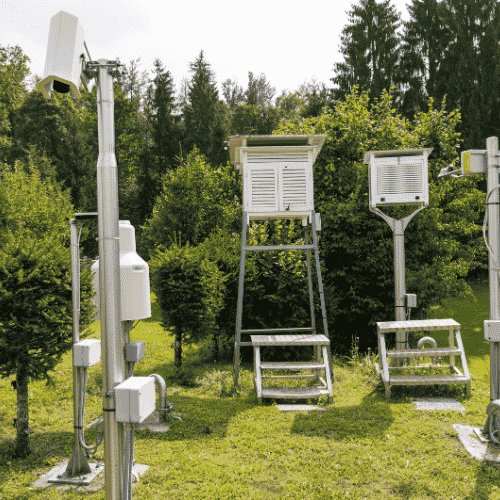
Weather and environmental conditions can change continuously throughout the day. For agriculture, meteorological research, environmental studies and controlled growing environments, occasional manual observations may not provide enough information to understand those changes.
An Automatic Weather Station (AWS) brings multiple environmental sensors together so important parameters can be observed continuously from one monitoring setup. Depending on the application, these parameters may include wind speed, wind direction, air temperature, relative humidity, solar radiation, soil moisture and leaf wetness.
For agricultural applications in particular, combining atmospheric and soil-level measurements can provide a much clearer picture of the conditions surrounding a crop.
Note: EMCON’s supplied documents provide detailed specifications for the individual sensors discussed below, but they do not yet include a dedicated Automatic Weather Station system datasheet covering the complete logger, telemetry or communication architecture. This article therefore focuses on the documented sensor layer rather than attributing unsupported AWS system features to EMCON.
What Does an Automatic Weather Station Measure?
The exact sensor configuration depends on the purpose of the station.
A general meteorological installation may focus primarily on wind, temperature, humidity and solar radiation. An agricultural or agro-meteorological station can extend this by monitoring soil moisture and leaf wetness.
Each parameter answers a different question:
- How fast is the wind moving?
- From which direction is it coming?
- What are the surrounding temperature and humidity?
- How much solar radiation is available?
- How wet or dry is the soil?
- How long are plant surfaces remaining wet?
When these measurements are considered together, they provide a more complete understanding of the local environment.
1. Wind Speed Sensor
Wind speed is one of the fundamental parameters in meteorological observation.
It helps describe changing atmospheric conditions and is also relevant to agro-meteorology, architectural studies, structural studies and climate-control research.
EMCON’s Wind Speed / Wind Velocity Sensor uses a three-cup anemometer with infrared pickup. Its documented measurement range is 0 to 60 m/s, equivalent to 0 to 216 km/h, with a threshold below 0.45 m/s. The sensor provides a digital pulse output and is designed for long-term outdoor measurement. WIND SPEED or VELOCITY CUP TYPE…
Why wind speed matters
In agricultural monitoring, wind conditions can influence the environment surrounding plants and crops. In wider meteorological observations, wind-speed data contributes to understanding local atmospheric behaviour.
EMCON lists meteorology, agro-meteorology, architectural studies, structural studies and climate-control chambers among the applications for this sensor. WIND SPEED or VELOCITY CUP TYPE…
2. Wind Direction Sensor
Knowing wind speed alone gives only part of the picture. A weather station may also need to determine where the wind is coming from.
EMCON’s Wind Direction Sensor uses a wind vane with a magnet-coupled, contact-free sensing arrangement. It measures direction across 0° to 360° with a stated accuracy of ±2°. EMCON – Wind Direction sensor
The contact-free sensing design is intended to reduce wear and support long-term operation. The sensor is also designed with resistance to water splash and dust contamination for outdoor use. EMCON – Wind Direction sensor
Why wind direction matters
Wind direction data complements velocity measurements by showing the movement pattern of air across a site.
For applications such as:
- Meteorology
- Agro-meteorology
- Architectural studies
- Civil and structural studies
- Climate-control observations
the combination of speed and direction provides substantially more information than either parameter alone. EMCON – Wind Direction sensor
3. Air Temperature
Air temperature is one of the most widely observed environmental parameters.
Changes in temperature affect atmospheric conditions, plant environments and controlled research spaces. Continuous temperature measurement therefore becomes important in meteorology, agro-meteorology, micro-meteorology and climate-control studies.
EMCON’s Combined Temperature / Relative Humidity Sensor uses a Pt1000 temperature sensor. Selectable temperature ranges documented by EMCON include:
- 0°C to 60°C
- -20°C to 60°C
- -20°C to 80°C
with a stated accuracy of ±0.2°C for these ranges. EMCON Combined ATRH Air Temper…
The sensor is designed for remote measurement and can be connected using longer cables for centralised observations. EMCON Combined ATRH Air Temper…
4. Relative Humidity
Temperature tells us how warm or cool the air is; relative humidity indicates the amount of moisture present in the air relative to its capacity at that temperature.
For agricultural and environmental studies, the two parameters are often more useful when measured together.
EMCON’s combined sensor uses a capacitance-based relative-humidity element covering a 0 to 100% range, with a stated accuracy of ±3% and repeatability of 2%. EMCON Combined ATRH Air Temper…
The documentation also specifies a protective shade intended to protect the sensing element from rain, dust and sunlight while allowing air movement around the sensor. EMCON Combined ATRH Air Temper…
Temperature + humidity together
Monitoring these two parameters together can support:
- Meteorological studies
- Agro-meteorology
- Micro-meteorology
- Architectural studies
- Civil and structural studies
- Climate-control chamber observations EMCON Combined ATRH Air Temper…
5. Solar Radiation Sensor
Sunlight is another important environmental variable, particularly in agricultural monitoring.
A solar-radiation sensor measures the amount of incoming solar energy received at a location.
EMCON’s Solar Radiation Sensor / Pyranometer uses a semiconductor sensing element and is available with documented ranges of 0–1500 W/m² or 0–1800 W/m². Its stated accuracy is ±3% of full scale, with a resolution of 1 W/m². SOLAR RADIATION SENSOR
EMCON lists applications including:
- Meteorology and agro-meteorology
- Agricultural investigation
- Agricultural evapotranspiration estimation
- Climate-control chambers
- Architectural and structural studies
- Air-pollution dispersion calculations SOLAR RADIATION SENSOR
This makes solar radiation especially valuable when the weather station is being used for agricultural or environmental research rather than simply basic weather observation.
6. Soil Moisture Sensor
An agricultural weather station often needs to look below the atmosphere and into the soil.
Soil-moisture measurements provide direct information about the wetness of the soil surrounding crops.
EMCON’s Capacitance-Based Soil Wetness-Moisture Sensor (EMC-SW-M-22) is designed for continuous observation directly in soil and engineered soils. It uses capacitive sensing and has a documented range of 0 to 100%, accuracy of less than 2%, repeatability within 1% and resolution of 0.1%. EMCON SOIL MOISTURE SENSOR
Where soil moisture monitoring is useful
EMCON lists applications including:
- Precision farming
- Precision irrigation
- Soil science
- Agro-meteorology
- Hydro-meteorology EMCON SOIL MOISTURE SENSOR
For agricultural monitoring, soil moisture adds an important ground-level parameter that cannot be determined from air temperature or humidity alone.
7. Leaf Wetness Sensor
Leaf wetness takes environmental monitoring directly to the plant surface.
EMCON’s Leaf Wetness Sensor continuously measures surface wetness or dampness and is specifically positioned for plant and crop disease prediction. The documentation states that the sensor is commonly used in AWS units for observations related to fungal or bacterial infection in plants and crops. EMCON-Leaf Wetness Sensor
It is a capacitance-type sensor with:
- 0 to 100% range
- ±1% stated accuracy
- Instant response
- Selectable 0–5 V or 3.3 V output
- UV-protected sensing surface EMCON-Leaf Wetness Sensor
EMCON lists meteorology, agro-meteorology, climate-control chambers and plant-growth chambers among its applications. EMCON-Leaf Wetness Sensor
Why leaf wetness is different from humidity
Humidity measures moisture in the surrounding air.
Leaf wetness measures the wetness present on the plant surface itself.
For agricultural studies, having both parameters can therefore provide different but complementary information about the crop environment.
How These Sensors Work Together
An Automatic Weather Station becomes more useful when parameters are selected around the purpose of the installation.
For a basic meteorological monitoring setup, the important parameters may include:
Wind Speed + Wind Direction + Air Temperature + Relative Humidity + Solar Radiation
For an agricultural or agro-meteorological monitoring setup, additional parameters such as:
Soil Moisture + Leaf Wetness
can provide information about conditions closer to the crop and root zone.
Rather than treating each sensor as an isolated instrument, the objective is to create a measurement set that describes the environment being studied.
Applications of Automatic Weather Monitoring
Based on the documented applications of EMCON’s individual environmental sensors, this type of monitoring can support areas such as:
- Meteorology
- Agro-meteorology
- Micro-meteorology
- Precision agriculture
- Precision irrigation
- Soil science
- Horticultural studies
- Agricultural research
- Evapotranspiration studies
- Climate-control chambers
- Plant-growth chambers
- Architectural studies
- Civil and structural studies
- Environmental research SOLAR RADIATION SENSOR EMCON SOIL MOISTURE SENSOR EMCON-Leaf Wetness Sensor
Choosing the Right Sensors for an AWS
Not every monitoring station needs every available sensor.
The right combination depends on what the project is trying to understand.
For general weather observations, wind speed, wind direction, temperature, humidity and solar radiation may form the core measurement set.
For agricultural monitoring, soil moisture becomes particularly relevant because it provides direct information about soil conditions. Leaf wetness can add another layer when plant-surface moisture and disease-related observations are important.
For research applications, sensor selection may be expanded or customised around the specific parameters being studied.
The key is therefore not simply to install as many sensors as possible, but to identify the parameters that meaningfully answer the research or monitoring requirement.
From Individual Parameters to Better Environmental Observation
An Automatic Weather Station is ultimately only as useful as the measurements it collects.
Wind speed describes air movement. Wind direction shows where it is coming from. Temperature and humidity describe atmospheric conditions. Solar radiation measures incoming solar energy. Soil moisture provides information below the surface, while leaf wetness brings monitoring directly to plant conditions.
Together, these measurements can create a much clearer view of changing environmental conditions than a single parameter alone.
For scientific, meteorological and agricultural applications, selecting reliable sensors suited to the deployment environment is therefore one of the most important parts of designing an effective monitoring system.
Planning an environmental or agricultural monitoring system?
EMCON designs and manufactures indigenous sensors for meteorological, agro-meteorological and environmental observations. Share the parameters you need to measure and the conditions in which the sensors will be deployed to discuss a suitable sensor configuration.
